

Biodiversity Conservation
By Samisoni Pareti, Senior Editor, Islands Business in New York
09 June 2017, UN Oceans Conference, New York - Strengthening the coastline of Tokelau's three inhabited atolls against the impact of storm surges and rising sea levels is a key part of the territory's climate change strategy.
Its 100 per cent reliance on solar energy is also a prominent feature of the plan, which Tokelau is calling its Living with Change national strategy on enhancing resilience to climate change and related hazards for 2017 to 2030.
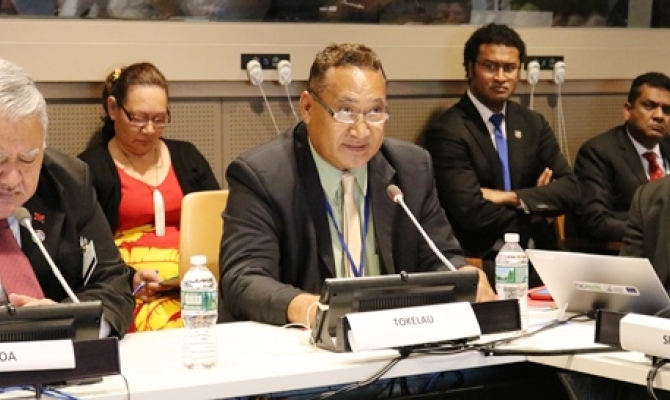
The head of the government of Tokelau, the Ulu o Tokelau Aliki Faipule Siopili Perez used this week's UN oceans conference in New York to launch his territory's Living with Change strategy.
Under it, Tokelau became the first country in the world to be 100 per cent reliant on solar energy in 2016. This the New Zealand-administered island atoll achieved in spite of geographic isolation, small population and a small land mass.
Reducing the risk of coastal inundation comes under the national strategy's adaptation measures. This will see coastal hazard risk reduction plan for the three coastal villages of Tokelau, as well as identifying measures to reduce the impact of storm surges. 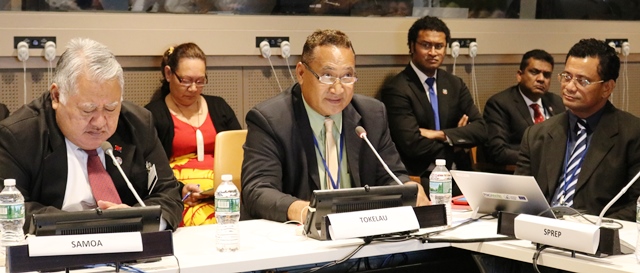
The Ulu o Tokelau said human development forms the third component of Living with Change strategy. It entails working with the governments of New Zealand and Monaco in the area of combating ocean acidification. It has already resulted in a projection inception and capacity building workshop last March.
"The workshop identified a list of priority activities for Tokelau, such as education and awareness raising on ocean acidification and climate change, review and strengthen management and governance of marine resources and scientific monitoring and reporting," said Aliki Faipule Siopili.
"Limiting climate change and ocean acidification would require substantial and sustained reductions in GHG emissions which, together with adaptation, can limit climate change and ocean acidification risks.
"And this is where we need every nation to play its part. Every nation should be compelled to act now by what I call the moral case: the idea that it is unjust that people of the Ocean, the poor, the disadvantaged, especially our children and future generation, will confine to, and inherit, oceans less healthy than they are now. " – S.Pareti/SPREP
09 June 2017, UN Oceans Conference, New York - Strengthening the coastline of Tokelau's three inhabited atolls against the impact of storm surges and rising sea levels is a key part of the territory's climate change strategy.
Its 100 per cent reliance on solar energy is also a prominent feature of the plan, which Tokelau is calling its Living with Change national strategy on enhancing resilience to climate change and related hazards for 2017 to 2030.
The head of the government of Tokelau, the Ulu o Tokelau Aliki Faipule Siopili Perez used this week's UN oceans conference in New York to launch his territory's Living with Change strategy.
Under it, Tokelau became the first country in the world to be 100 per cent reliant on solar energy in 2016. This the New Zealand-administered island atoll achieved in spite of geographic isolation, small population and a small land mass.
Reducing the risk of coastal inundation comes under the national strategy's adaptation measures. This will see coastal hazard risk reduction plan for the three coastal villages of Tokelau, as well as identifying measures to reduce the impact of storm surges.
The Ulu o Tokelau said human development forms the third component of Living with Change strategy. It entails working with the governments of New Zealand and Monaco in the area of combating ocean acidification. It has already resulted in a projection inception and capacity building workshop last March.
"The workshop identified a list of priority activities for Tokelau, such as education and awareness raising on ocean acidification and climate change, review and strengthen management and governance of marine resources and scientific monitoring and reporting," said Aliki Faipule Siopili.
"Limiting climate change and ocean acidification would require substantial and sustained reductions in GHG emissions which, together with adaptation, can limit climate change and ocean acidification risks.
"And this is where we need every nation to play its part. Every nation should be compelled to act now by what I call the moral case: the idea that it is unjust that people of the Ocean, the poor, the disadvantaged, especially our children and future generation, will confine to, and inherit, oceans less healthy than they are now. " – S.Pareti/SPREP